Forty names, no cup‑ties: CAF rewrites the Interclub squad rules
8 min read
Forty and free to move. CAF has overhauled its Interclub regulations in a way that will be felt immediately in the Champions League and Confederation Cup: clubs can now register up to 40 players, and the long‑standing cup‑tied restriction is gone. Those two decisions, confirmed after a virtual CAF Executive Committee meeting chaired by Patrice Motsepe on Friday, October 2, 2026, open up new room to manoeuvre for teams juggling domestic and continental demands.
There is still structure around the flexibility. The final registration period will allow clubs to replace up to four players, but only if the outgoing names have not featured in a CAF Interclub match in the same campaign. New arrivals must be lodged at least 72 hours before kick‑off to be eligible, and matchday benches remain capped at nine substitutes and nine technical staff. Put together, the changes alter how sporting directors think about depth and how coaches plan mid‑season reinforcements for the latter stages of Africa’s two premier club competitions.
What exactly has changed — and what hasn’t
CAF’s headline adjustment is a bigger squad list: from now on, Interclub participants can register as many as 40 players for a campaign. In a calendar notorious for long trips across the continent, compressed turnarounds and injuries, that headroom is designed to give clubs greater resilience without resorting to emergency measures. The rulebook’s stay‑the‑same elements are equally important: teams are still required to register any new player at least 72 hours before kick‑off to field them, and the matchday bench remains fixed at nine substitutes and nine technical staff.
Two procedural tweaks sit alongside the 40‑man ceiling. First, during the final registration period clubs are permitted to replace up to four names. The protection built in is explicit: you cannot take off a player who has already appeared in a CAF Interclub match and swap them for someone else. Second — and most disruptive to the transfer market — CAF has removed the cup‑tied rule. A player who has featured for one participating club earlier in the campaign can now represent a different participating club later in the same campaign.
| Area | New regulation |
|---|---|
| Squad registration limit | Up to 40 players |
| Cup‑tied status | Removed; a player may represent another club after featuring this campaign |
| Final registration period | Up to four replacements allowed |
| Replacement condition | Only players who have not featured in a CAF Interclub match may be replaced |
| Eligibility timing | New players must be registered at least 72 hours before kick‑off |
| Matchday bench | Nine substitutes and nine technical staff allowed |
Why CAF moved now: travel, injuries and calendar squeeze
The logic CAF set out is pragmatic: more flexibility to meet a relentless continental season. Clubs playing both at home and across Africa face congested schedules, injury risks and fatigue accentuated by extensive travel. A 40‑player list acknowledges that reality by letting teams carry a deeper pool without constantly cutting and re‑adding names as they negotiate multiple competitions and long‑haul flights.
Friday’s virtual Executive Committee meeting, chaired by President Patrice Motsepe, codified that stance. The steadying hand in the reforms is the retention of the 72‑hour eligibility gate and fixed matchday bench. Both constraints prevent a free‑for‑all while still easing the load on medical departments and coaching staffs who have had to manage with short squads through dense blocks of fixtures. In short: CAF has dialled up depth without discarding order.
Mid‑season transfers now carry a new logic
The most eye‑catching piece is the removal of the cup‑tied provision. Previously, a player who had already appeared in the Champions League or Confederation Cup for one club was locked out of representing another in the same campaign. That is no longer the case: clubs can sign someone mid‑season who has already featured for a different participant and still deploy them later in the competition, subject to the standard 72‑hour registration cut‑off.
CAF has paired that freedom with guardrails. The four permitted replacements in the final registration window cannot be used to jettison players who have already taken the field in Interclub matches. In practice, that means sporting directors must plan their winter strengthening around available registration slots or around squad members who haven’t yet featured. The net effect is to open doors for reinforcements while avoiding churn that would undermine the competitive integrity of earlier rounds.
For players, the calculus changes too. The ability to move and remain eligible may unlock opportunities that were previously off the table during the mid‑season window. For clubs eyeing a deep run, the reform makes scouting and recruitment during the campaign more valuable, with the 72‑hour eligibility rule setting a clear administrative deadline: deals have to be done in time, or the new man watches from the stands.
A 40‑player cap reshapes squad‑building and rotation
A broader list gives coaches latitude to cope with the double grind of domestic and continental play. With injuries and fatigue a fact of life on Africa’s travel‑heavy routes, carrying more options reduces the risk of patch‑up selections and short‑rest overuse. It also creates space to manage workloads more deliberately across competitions, rather than running the same core into the ground from August to May.
The ability to hold 40 registrations does not change the matchday cap of nine substitutes, so the competitive decision‑making on a given night remains tight. But across a campaign, the extra room matters. Teams can keep specialised profiles available for specific opponents, protect against sudden injuries without scrambling, and maintain a stable training group even as domestic and continental fixtures ebb and flow.
Matchday management: nine on the bench, nine in the dugout
CAF has kept the matchday bench rules unchanged: clubs can name nine substitutes alongside nine members of the technical staff. That continuity makes the new flexibility more predictable. Coaches will still be working with the same substitution choices on a given night; what changes is the pool they draw those nine from, and the ability to cycle through options without exhausting the registration quota.
The steady bench limits also simplify logistics. Even as lists lengthen to 40, training and travel groups for away ties can be trimmed to match operational realities, with the knowledge that the broader squad is eligible when needed. The 72‑hour registration requirement remains the decisive checkpoint: eligibility hinges on paperwork being completed in time, not on ad‑hoc matchday decisions.
The detail
Inside the list: how the final window and no cup‑ties interact
Two mechanisms define the new mid‑season landscape. First, the final registration period allows up to four replacements — but only if the outgoing players have not featured in a CAF Interclub match that campaign. That clause is a hard stop: any player who has stepped on the pitch in the Champions League or Confederation Cup cannot be de‑registered to make way for someone else during that window. Second, the abolition of cup‑ties means an incoming player can be eligible even if he has already appeared for another participating club earlier in the same campaign. In practice, list managers have to juggle three levers simultaneously: overall headcount (now up to 40), the availability of non‑featured players who can be replaced during the final window (capped at four), and the 72‑hour pre‑kick‑off deadline that governs match eligibility. If the list is full, space during the final window can be created by removing someone who has not yet featured, up to four such changes. The no‑cup‑tie environment widens the pool of potential signings, but the replacement cap and eligibility timing keep the churn contained and predictable.
Risks, opportunities and the built‑in safeguards
Greater flexibility invariably invites worries about competitive balance. CAF’s framework addresses that by combining opportunity with limits: lists can grow to 40, but only four replacements are possible in the final registration period, and not at the expense of players who have already appeared. That condition rewards clubs that plan their early‑round usage carefully, keeping room to manoeuvre later without rewriting the spine of a team that qualified on the field.
The 72‑hour eligibility rule is the other brake. It forces clubs to conclude deals and registrations well in advance of a match, preventing last‑minute gambits and maintaining a clear, consistent administrative threshold across the competition. Meanwhile, the unchanged nine‑substitute matchday bench ensures that, even with deeper lists, games are still decided within familiar tactical parameters — by coaching choices among nine options, not by an endlessly rotating cast.
How clubs are likely to adapt this campaign
Expect technical teams to map their 40‑man lists around the calendar hotspots, holding a margin for injuries and the travel‑induced fatigue CAF explicitly cited. The removal of cup‑ties will sharpen mid‑season scouting: players who impress early for one side may become viable targets for another looking to strengthen for the latter stages. But the replacement cap means clubs will balance any pursuit against their available non‑featured slots and the need to protect continuity.
The administrative rhythm becomes more important too. Sporting departments will work backwards from the 72‑hour eligibility mark when planning additions, ensuring medicals and paperwork are aligned well ahead of key fixtures. With nine substitutes and nine technical staff still the matchday constants, the on‑pitch chess remains familiar; the difference is that coaches can curate those benches from a broader, fresher, better‑managed group over the course of a long continental campaign.

The bottom line for the Champions League and Confederation Cup
CAF’s reforms are pragmatic and targeted: a 40‑player ceiling to meet the grind of travel and fixture congestion, a final‑window swap allowance with strict conditions, the abolition of cup‑ties to unlock mid‑season market flexibility, and firm administrative guardrails in the 72‑hour rule. For clubs across the Champions League and Confederation Cup, that means deeper lists, more options to reinforce, and fewer dead ends when injuries strike.
The competitive dynamics should feel familiar on matchdays, but different across months. The teams that benefit most will be those that plan best — budgeting their four late replacements, protecting registration space, and hitting the paperwork deadlines — while using the new eligibility landscape to add the right piece at the right time. As the campaign unfolds, the impact of “forty and free to move” will be measured not just in who signs whom, but in who manages the margins most effectively.
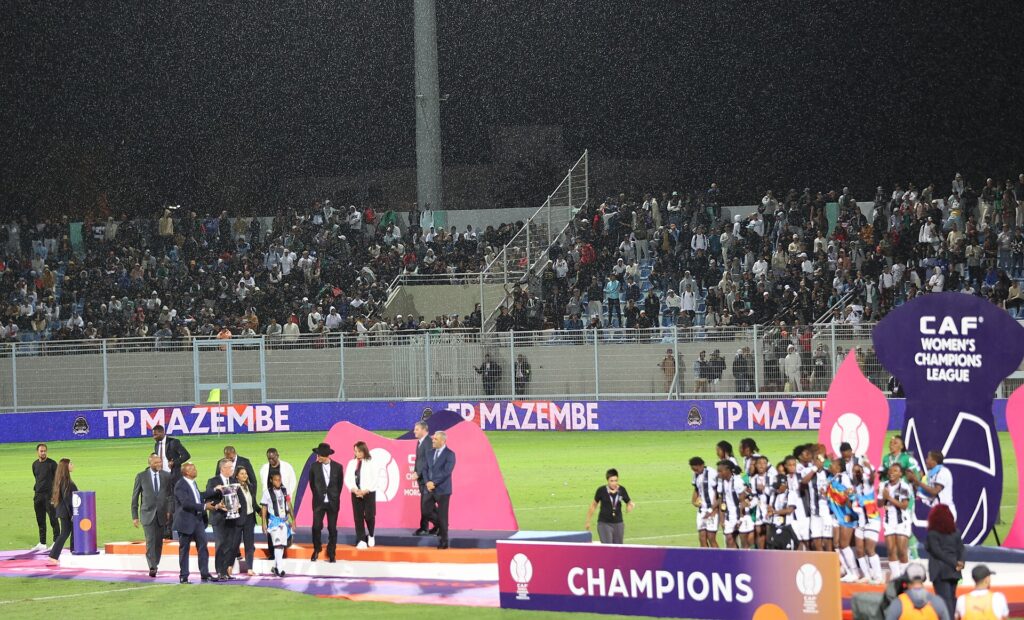
Sources: CAF increases Interclub squad limit to 40 players (ghanasoccernet.com)
Images: Cover: CGZ G3N3 / Wikimedia Commons (CC BY-SA 4.0); Figure 1: Copyright by World Economic Forum swiss-image.ch/Photo by Monika Flueckiger / Wikimedia Commons (CC BY-SA 2.0); Figure 2: Reda benkhadra / Wikimedia Commons (CC BY-SA 4.0)
How this article was made: Football Africa uses AI tools to structure, format and optimise its articles, and occasionally to produce illustrated covers where no free photograph exists. The reporting these articles are based on is human-produced and cited above. Spotted an error? Write to [email protected] and we will correct it. — The editors How we work.